Series: Plain Sight · No. 1 · An explainer · last reviewed 29 October 2026
In brief
- Sometimes a business or a program that many people rely on stops because someone far away makes a decision. I call this the switch someone else holds.
- The public record includes a youth training program, an online shop, a lender and a job website that stopped in Tanzania, in each case after a decision by a funder or a company's leadership.
- NGOs are the charities and non-profits that run programs in health, education, farming and more. In a 2018 survey of Tanzanian organizations, most funding came from international NGOs, and international aid has fallen since.
- Very few studies check what happens to a program after its funding ends. Business exits are also rarely explained.
- Most of this information is already public. It has just not been put side by side. This piece does that, says how sure we can be about each point, and offers five questions any leader or funder can ask.
Who this is for. People who run, fund, work in or write about NGOs and businesses in Tanzania, and anyone curious about why programs stop. It is an explainer, not a verdict. No organization named here is being accused of anything. Companies and funders have good reasons to change their plans, and every source is linked so you can check it.
About this series. Plain Sight looks at facts that are already public but rarely put side by side, and asks what they mean in practice. Each piece says how sure we can be.
The numbers to remember
- 71%. Share of funding from international NGOs among Tanzanian organizations surveyed in 2018. Local sources gave under 10%.
- 9%. How much worldwide aid fell in 2024, according to the OECD.
- $25.2M to $11.5M. USAID education funding to Tanzania from 2021 to 2024, as reported.
- 9 of 4,876. Studies that met one review's standards on whether donor-funded health programs continue after funding ends.
- 1%. Share of development projects checked after donor funding ends, as quoted in one paper.
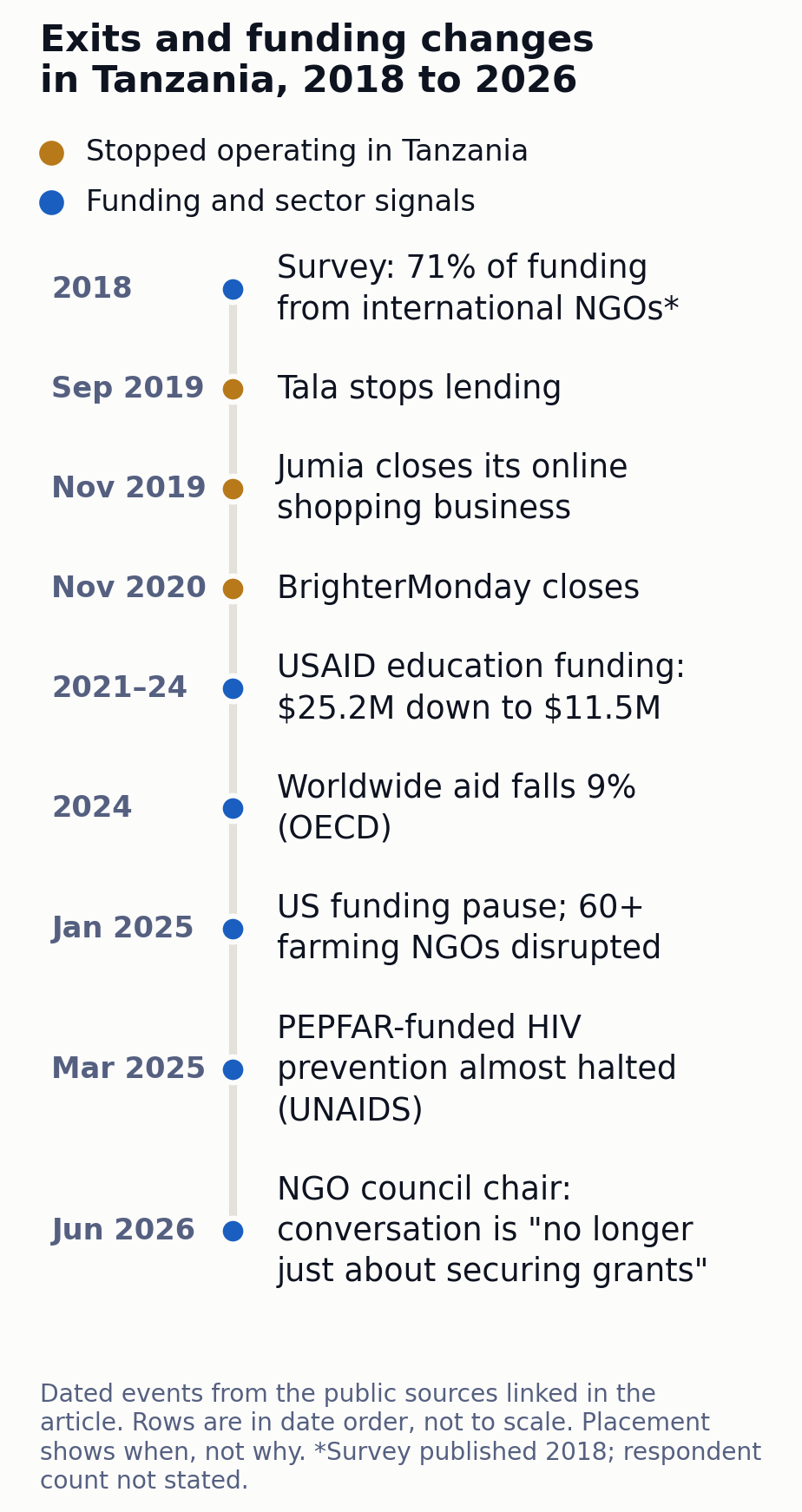
The pattern in one picture
Finding 1. A program or business can stop because of a decision made elsewhere
How sure are we? Solid that these stopped. Only partly known why.
A vocational training center in Dar es Salaam had 200 students enrolled for the next term. Then the program behind it closed. CARE, an organization that worked with the program, says the students could not finish their training or get certified.
The program was Kijana Nahodha, a four-year, $10.5 million initiative funded by the United States. It aimed to give more than 40,000 young Tanzanians job skills and certificates, and it was due to run until 2026. The center was one of its 14 sites. CARE describes the closure as "abrupt." That is CARE's account, and funders have reasons for their decisions that are hard to see from outside. The point is not who was right. The point is that the center had no way to change the outcome, and 200 students were affected.
Think of a light switch in another room. The people in the first room need the light, but someone else decides when it goes off. Many organizations have a switch like this: one decision-maker can end something that many people depend on.
Businesses show it too. In November 2019, Jumia closed its online shopping business in Tanzania. It said it needed to "focus resources" on other markets. Two months earlier, the lender Tala had stopped lending in Tanzania. Techpoint reported that the company did not give a public reason and said legal restrictions limited what it could say. On 30 November 2020, the job website BrighterMonday closed. Its CEO pointed to the "current economic environment" and said many employers hired by word of mouth, not data. Its parent company said it would keep operating in markets where its businesses were "clear market leaders with a bright future."
These cases are different, and I am not suggesting anyone acted in bad faith. Companies and funders have many needs to balance. What the cases share is this. The decision was made somewhere else. It made sense to the people making it. And it reached people who were not in the room. Of the three business examples, only one explanation says anything about Tanzanian customers. So the public record cannot tell us whether weak local demand played a part in any of them. The people behind these decisions were making hard choices, and I respect that.
Finding 2. Many Tanzanian NGOs have relied mainly on money from outside the country
How sure are we? Solid for the 2018 survey, but it is dated. The number of respondents is not published.
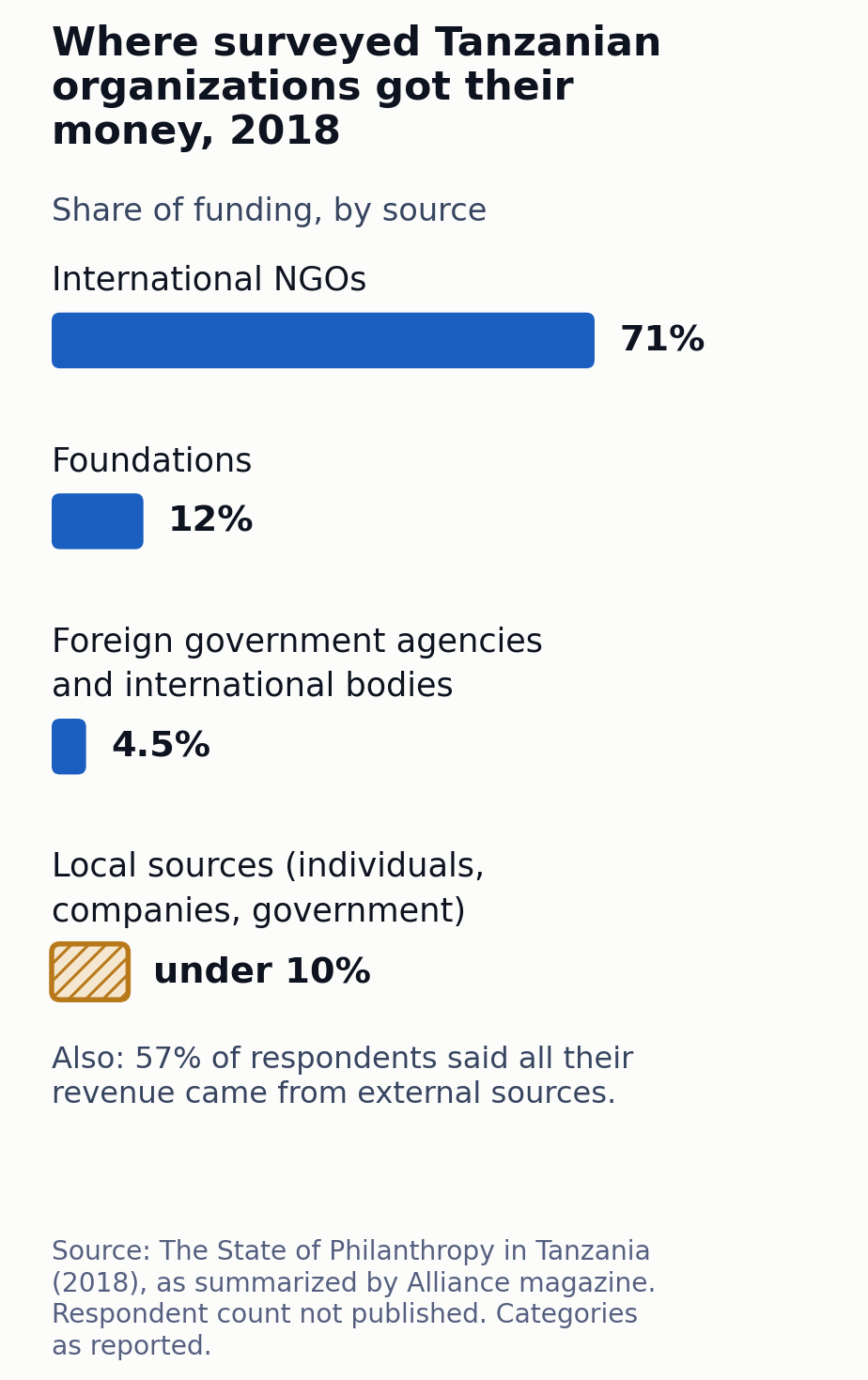
The State of Philanthropy in Tanzania asked organizations where their money came from. Among those surveyed, international NGOs gave 71 percent of the funding. Local sources, such as individuals, companies and government, gave under 10 percent together. Fifty-seven percent of the organizations said all of their money came from outside sources. The survey cannot show whether this has changed since.
Finding 3. The supply of outside money has tightened since
How sure are we? Solid for the worldwide trend. For Tanzania, some figures are estimates or one expert's view, and the text says which.
- Worldwide. The OECD, a group that tracks international aid, reports that aid fell 9 percent in 2024. It expects a further drop of 9 to 17 percent in 2025. In 2024, France, Germany, the United Kingdom and the United States all cut their aid in the same year. That had not happened in nearly 30 years. Together these four give about two-thirds of the aid that goes to the world's least developed countries and to sub-Saharan Africa.
- In Tanzania, before 2025. A policy paper by a Tanzanian research group, the Economic and Social Research Foundation, says the United States gave Tanzania about $450 million in 2024 for health, education, farming and more. The Guardian reported it. The same article says USAID's education funding had already fallen from $25.2 million in 2021 to $11.5 million in 2024.
- In 2025. In January, The Citizen reported that more than 60 NGOs working in farming and food businesses faced disruption after a pause in US funding. One agribusiness expert estimated about 65. The same expert said some of them get up to 30 percent of their money from USAID. That is one person's estimate. In March, UNAIDS reported that HIV prevention programs fully funded by the US PEPFAR program had almost completely stopped. Support to regional and local health offices was also paused. UNAIDS noted that the Tanzanian government had promised money to keep HIV medicines free and available.
- Now. In June 2026, Jasper Makala, chair of the National Council of NGOs, told The Citizen that "the conversation is no longer just about securing grants." The aim, the chair said, is a sector "less dependent on external financing." The council announced that its 2026 National NGO Forum would focus on domestic sources of funding.
None of this is a judgment on any donor's right to decide how to use its money. The question is what happens to the people who depend on a program when it ends.
Finding 4. Very little is known about what happens after funding ends
How sure are we? Thin. Nine studies, mostly in health, and two figures repeated from other sources.
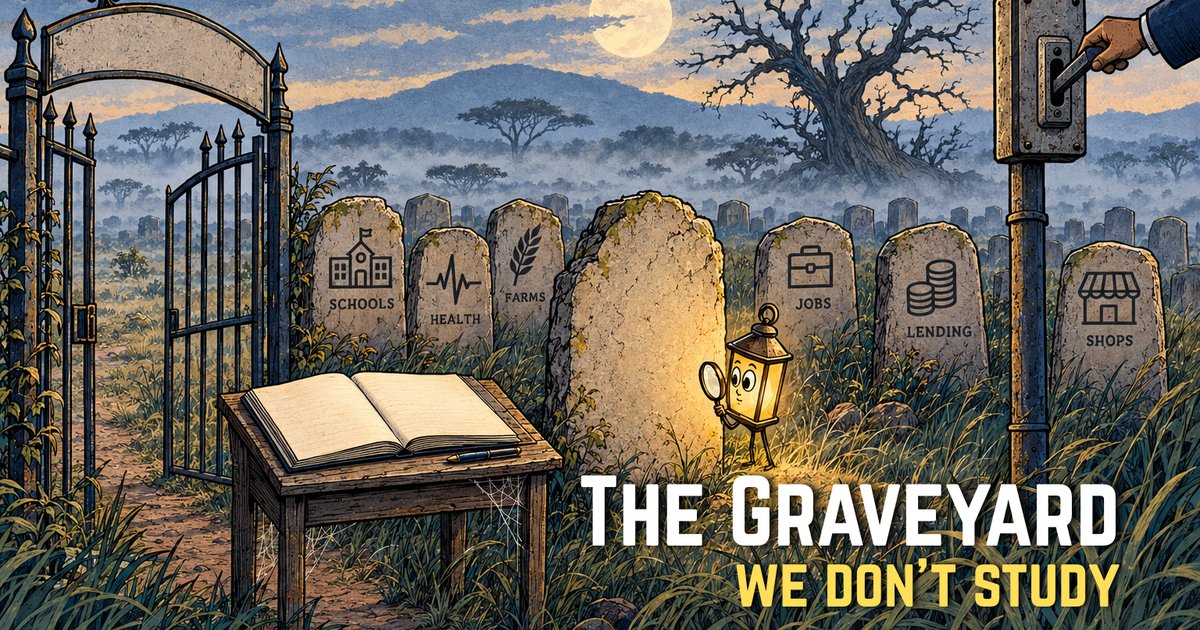
This is the graveyard we don't study: the programs and businesses that ended, and what followed.
A 2022 review gathered the studies it could find on donor-funded health programs in Africa. Of 4,876 articles, only nine met its standards. In seven of those nine (about 78 percent), the program kept going after funding ended. Programs lasted longer when communities owned them, used local resources and had capable teams. They struggled when health systems were weak, money ran short, or donors and communities did not communicate well.
Nine studies are too few to call a rate. A paper in PLOS ONE about US-funded health services in South Africa says that "the literature estimates at least 40–50% of social programs collapse within a year after funding ends." It also says very few (1 percent) development projects are checked after donor funding ends. The paper repeats both figures from other sources. The two sets of numbers differ because they measure different things in different places. What they share is that few programs are followed up.
Finding 5. Business exits are hard to read too
How sure are we? Unclear. One widely quoted number has no published method, and the example below is the founders' own account.
If you read about Tanzanian startups, you will meet one figure: 60 to 70 percent fail within three years. The Citizen attributes it to a study by the Tanzania Investment and Consultant Group. The article does not say how the study counted failure or how many companies it covered. So it is hard to know how far to rely on the number. I would treat it as a question to explore, not a conclusion. Publishing the method would help everyone, including those of us who quote numbers.
One business held its own switch. In an interview with Atoms & Bits, the founders of Piki, a food and grocery delivery app, say it launched in December 2019 with $600,000 to $800,000 of their own invested and reinvested money and no outside funding. They say it has been profitable for 3.5 years. Those are the founders' figures, not audited ones. Having no outside party who could change its plans may have helped, but that is my reading, not a finding. Many other things matter too.
Five questions worth asking
These come from the pattern above. They are questions, not rules, and they apply to every organization, including mine. Feel free to use them in a team or board meeting.
- Who could end this work without our agreement?
- How much of our money comes from our single biggest source?
- If the money stopped, what should keep running, who would own it, and who would pay?
- Who will check what happened two or three years later?
- Where will we write it down, in plain words, for the next person?
What we do not know
- Whether the local share of NGO funding has changed since 2018.
- Why Jumia, Tala or BrighterMonday decided as they did, beyond what they said publicly.
- How often programs in Tanzania continue after funding ends, especially in education.
- How the 60 to 70 percent startup figure was calculated.
A note on my own position
I work in this sector too, so these questions apply to my own work as much as anyone's. I offer them as things to ask, not as answers I have already worked out. If you spot something I missed, or a newer figure, please tell me through the contact page. I would rather correct it than leave it.
Three small asks
To funders: consider a small line in the budget for a check two or three years after a grant ends. To organizations and founders: when you stop or shrink something, a short public note on what ended and what you learned helps the next person. To journalists and researchers: a shared public record of exits, with sources, would help all of us check claims.
Switches will sometimes be flipped, and often for good reasons. The useful question is whether the people who depend on the light were ready, and whether anyone wrote down what happened.
Your turn
Which of the five questions would be hardest for your organization to answer? I would like to hear it, on LinkedIn or through the contact page. Your answer may show something I have missed.
Worth a closer look
If you read one source from this piece, read the 2022 review of donor-funded health programs. It is the clearest look I found at what helps a program continue after the money ends.
Follow Plain Sight. New pieces appear on this site, on LinkedIn and on Substack.
Sources and method
Every figure comes from the public sources below. Where a figure is secondhand, an estimate or a company's own claim, the text says so. Nothing here was independently audited. The evidence on what happens after funding ends comes mostly from health and agriculture, not education.
- Official and international bodies. OECD, Cuts in official development assistance (June 2025). UNAIDS, Impact of US funding freeze on HIV programmes in Tanzania (11 March 2025).
- Research. Ilesanmi and Afolabi (2022), Sustainability of donor-funded health-related programs beyond the funding lifecycle in Africa, Cureus. Chiliza and colleagues (2021), Program sustainability post PEPFAR direct service support in the Western Cape, PLOS ONE.
- Survey summary. Alliance magazine (2018), Tanzanian philanthropy sector still dependent on external funding.
- Organization account. CARE, Opportunity lost: the human cost of aid cuts in Tanzania.
- News reports. The Citizen: Why e-commerce giants exit Tanzanian market; USAID funding halt puts Tanzania NGOs, agriculture at risk (28 January 2025); Tanzania NGOs shift focus to domestic funding (12 June 2026); Why Tanzania's startup ventures fail to survive beyond three years. Techpoint, Tala halts lending operations (18 September 2019). The Guardian (Tanzania), USAID funding disruptions (21 March 2025).
- Interview. Atoms & Bits, How Piki became profitable.
Thanks to The Citizen, Techpoint, The Guardian (Tanzania), Atoms & Bits, Alliance magazine, CARE, UNAIDS and the OECD for the public work this builds on.
How to cite: Kamukulu, M. (2026, October 29). The Graveyard We Don't Study. michaelkamukulu.com. https://michaelkamukulu.com/writing/the-graveyard-we-dont-study/
Michael Kamukulu is the Executive Director of LearnImpact. Figures are as reported by the sources listed above and were not independently audited.