In 2019, Vietnam wrote something unusual into law: at least one in every five Vietnamese Dong (20%) of state spending must go to education. Not an aspiration. Not a Vision-document line. A legal floor.
Vietnam’s own National Assembly records show that in the twenty years the target has existed, the country has never once met it. Some years it has come close. In 2023 it fell to its lowest point in a decade. This August, the government reaffirmed the same 20 percent floor again, in a new resolution, with additional sub-targets attached — effectively admitting, in public, that the first version of the promise had not held.
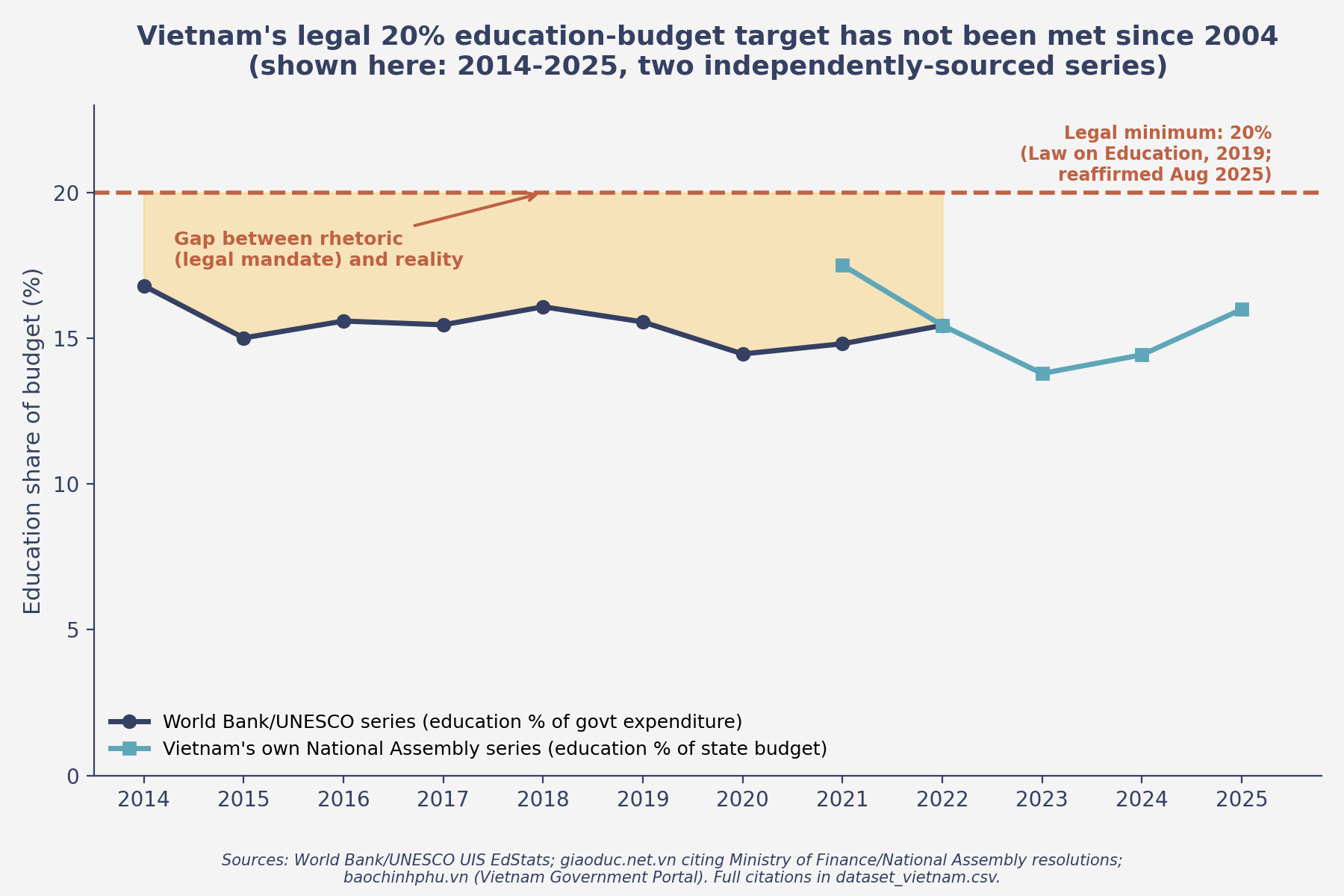
I want to be careful with what that means. It is not proof that legal targets fail. It is proof of something more useful: that even a specific, binding, checkable number is hard to hit, and a government will still fall short of it under pressure. But there is a real difference between falling short of a number you wrote down, in public, in law — and never writing one down at all. Vietnam’s own press can run a headline saying the government missed its target for the twentieth year running. That is possible only because Vietnam gave its own citizens a number to check.
I have spent about a month with six East African countries’ national budgets — Tanzania, Kenya, Uganda, Rwanda, Burundi and South Sudan — line by line, ten years back from 2026, cross-checked against every one of their own long-term Vision documents. Roughly 470 individual figures, each one traced to a page in a government document, a budget speech, or a credible independent monitor. Not one estimate. Not one number filled in because it looked about right.
Here is what I found: none of the six has done what Vietnam did. Not one.
A hundred promises, and not one of them a number you can check
Every government in the region has a document like Vietnam’s — a Vision, stretching out to 2040, 2050, sometimes 2060. Between the six, they set well over a hundred specific, quotable targets: literacy rates, digital-service percentages, technology indices, export shares, connectivity goals. Rwanda’s talks about a knowledge economy built on innovation. Uganda’s promises a literacy rate of 95 percent and an economy exporting far more in ICT services than it does today. Tanzania’s newest, tabled in Parliament last year, promises 70 percent digital literacy and four in five government services online by 2050.
Not one of the six sets a target for what share of the national budget education, or the digital economy, should actually receive.
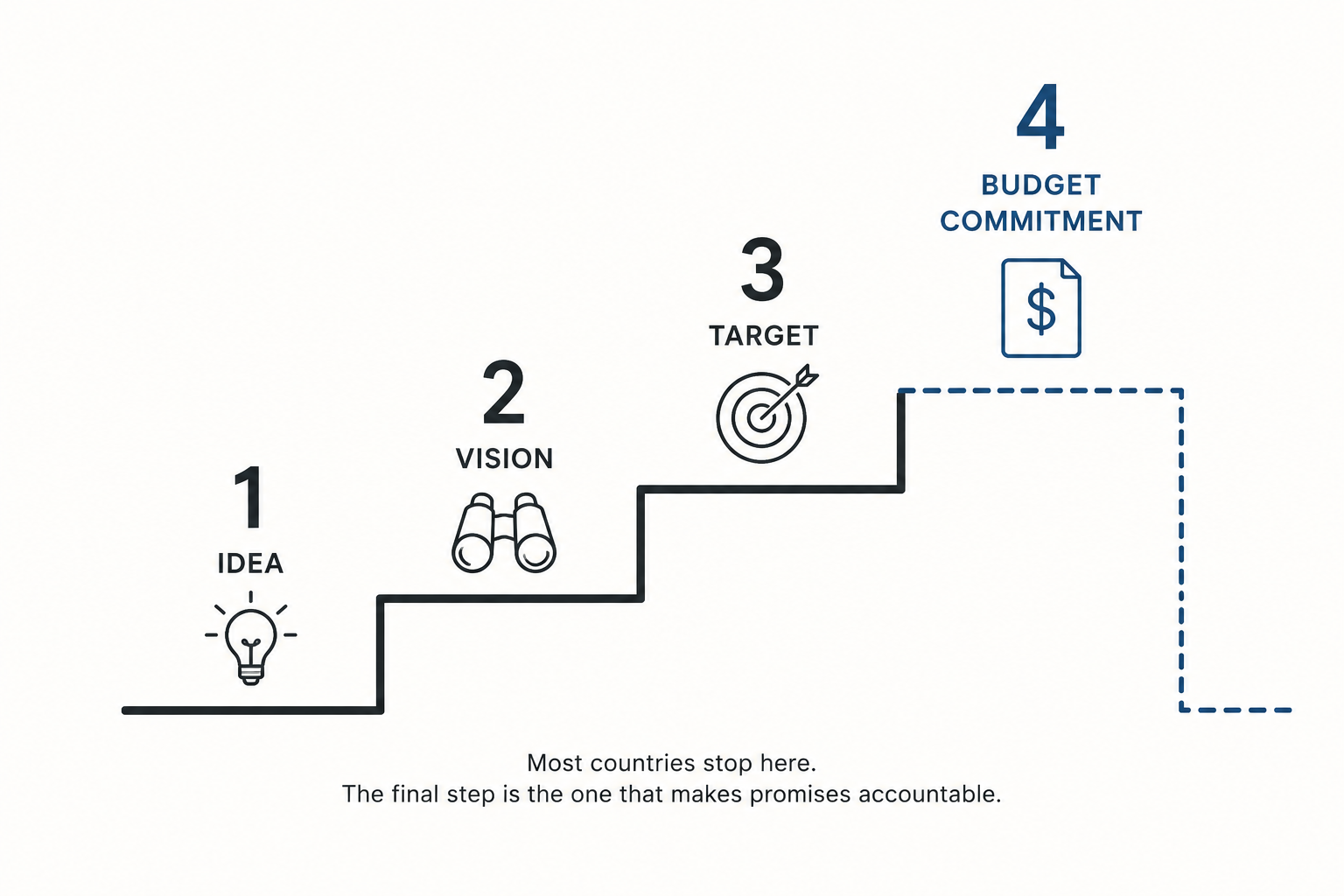
This is not a small omission. It means that when a country’s education budget share falls year over year, no law has been broken and no promise has technically been missed — because no government in this sample made a promise about the share in the first place. Rwanda’s own planning documents talk at length about Kigali Innovation City and a digital future, and never once put a number on what share of the budget that future should command. Nobody can call that a broken promise. Nobody was ever given the number to check it against.
Ghana shows this is a choice, not a limitation of what’s possible on this continent. Since 2000, Ghana’s Education Trust Fund has earmarked, by law, a fixed share of VAT revenue specifically for education — a real, binding mechanism, not a Vision-document aspiration (Ghana’s own government later clawed back part of it in 2017, which is its own lesson: even a legal earmark needs defending). Still, it is proof that an African government can write a number down. None of the six countries in my study has chosen to.
The share is shrinking, even as the number gets bigger
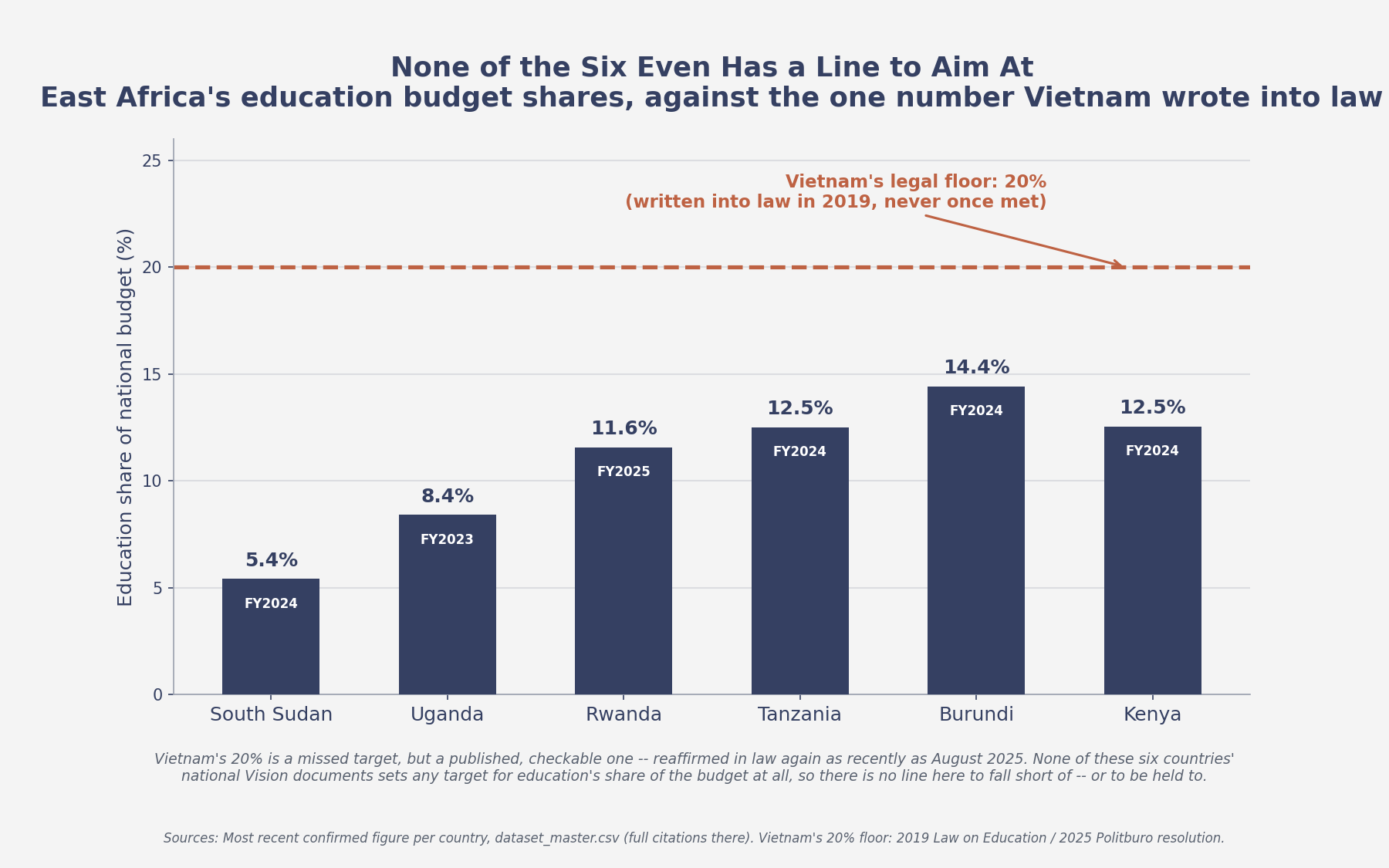
Uganda’s Ministry of Education’s own budget line — the figure most people would find if they searched for it — makes education spending look almost invisible, close to 2 percent of the national budget. That is not because Uganda spends nothing on schools. Most of its actual classroom spending — teacher salaries, capitation grants — flows through local government, outside the ministry’s own vote entirely. Add that in, using the same sector-wide accounting Uganda’s own civil society budget monitors use, and education’s real share was 8.7 percent in 2022/23. By the following year it had slipped to 8.4 percent.
Tanzania’s version of the same pattern is larger in scale but the same shape: the sector’s real share of the national budget was 16 percent in 2016/17. By this year, 12.5 percent. Every year the education budget has grown in shillings — a government can always point to a bigger number, and it will be true — but it has grown more slowly than everything else the government spends money on. Tanzania’s own HakiElimu, the country’s longest-running education-budget monitor, has flagged this directly: its former Executive Director Dr John Kalage told press in May this year that Tanzania has now missed the regional 15-20 percent benchmark for education spending (the Incheon Declaration standard, which Tanzania itself endorsed in 2015) for five consecutive years running, and called for the government to “align political will with budgetary commitment.”
Only one country in this sample bucks the trend entirely. Kenya’s education budget share has risen over the decade — from 8.3 percent in 2016/17 to 12.5 percent this year — driven in large part by a hundred-thousand-intern teacher hiring programme and a new national curriculum with its own dedicated funding line. It is not a spotless story — Kenya’s own Treasury leadership has publicly conceded gaps between promised and delivered funding for free education — but directionally, Kenya is doing something the rest of the region is not, and it deserves its own closer look, which is coming.
Building versus staffing
A second, quieter finding matters nearly as much as the headline. Tanzania and Uganda fund education mostly through capital and development budgets — new buildings, new equipment, new projects — while Kenya’s education budget is overwhelmingly recurrent: salaries, materials, the unglamorous cost of keeping a system running rather than expanding it.
Both approaches have a case. But a system that spends the majority of its education budget on capital projects is a system perpetually building new capacity it may not be resourced to staff at the same pace — and this is not hypothetical. Uganda’s own Auditor General found that of 117 “Seed” secondary schools built under one national programme, only 12 were fully staffed; one, in Kyenjojo district, was serving 260 pupils with no teachers at all, running on unqualified volunteers. This is the kind of structural choice that decides whether new investment reaches a classroom or just adds another building to maintain.
The ask
None of this is an argument against ambition. Vision 2050, Vision 2040, Vision 2030 — these documents matter, and the targets inside them are not wrong to want. But a Vision without a budget-share commitment is a promise with no way to check it. Vietnam’s twenty-year story is not a model to copy blindly — a law alone does not guarantee delivery. But it is proof that a government can choose to give its own citizens a number to hold it to, and that the alternative — writing everything down except the one figure that would let anyone check — is also a choice.
If the debates ahead of us — about how far and how fast to take proven education programmes across the region — are going to mean anything, they should start here: put a number on the table, publish it, and let the citizens whose children sit in these classrooms hold their governments to it, the way Vietnam’s own press now can. Anything less, and a Vision document is just a very well-designed piece of paper.
This analysis draws on a ten-year, six-country budget dataset built from primary government sources, plus each country’s own national Vision document; the full dataset and methodology are available on request.