(a note before this one: the boy’s name has been changed, as have identifying details, to protect him. what follows is true in substance, gathered during a visit to Lushoto in September 2026.)
In northern Tanzania, there is a road outside Lushoto town that climbs through tea and cardamom, past children walking to school in packs, backpacks bouncing, uniforms bright against the green. Baraka used to walk that road. Not anymore.
He is fourteen. Old enough to understand exactly what he was giving up when he stopped walking it.
His family’s story is not unusual here, which is precisely what makes it worth telling. His father farms a small plot that gives less each year. His mother sells vegetables at a market three kilometers from home. There is a school fee that isn’t officially a fee, since primary education in Tanzania is free, except it never quite is: exercise books, a uniform, contributions the school calls voluntary but treats as mandatory, costs that can easily outstrip a week’s income for either parent.
And there is a younger sister, seven years old, just starting the grades where everything about a child’s future gets decided, whether they learn to read on time or fall permanently behind.
Baraka did the math a fourteen year old should never have to do. If he stayed in school, the household could not cover both his costs and hers. If he left and worked, casual labor, whatever a boy his size could find, he could cover hers alone.
So he left.
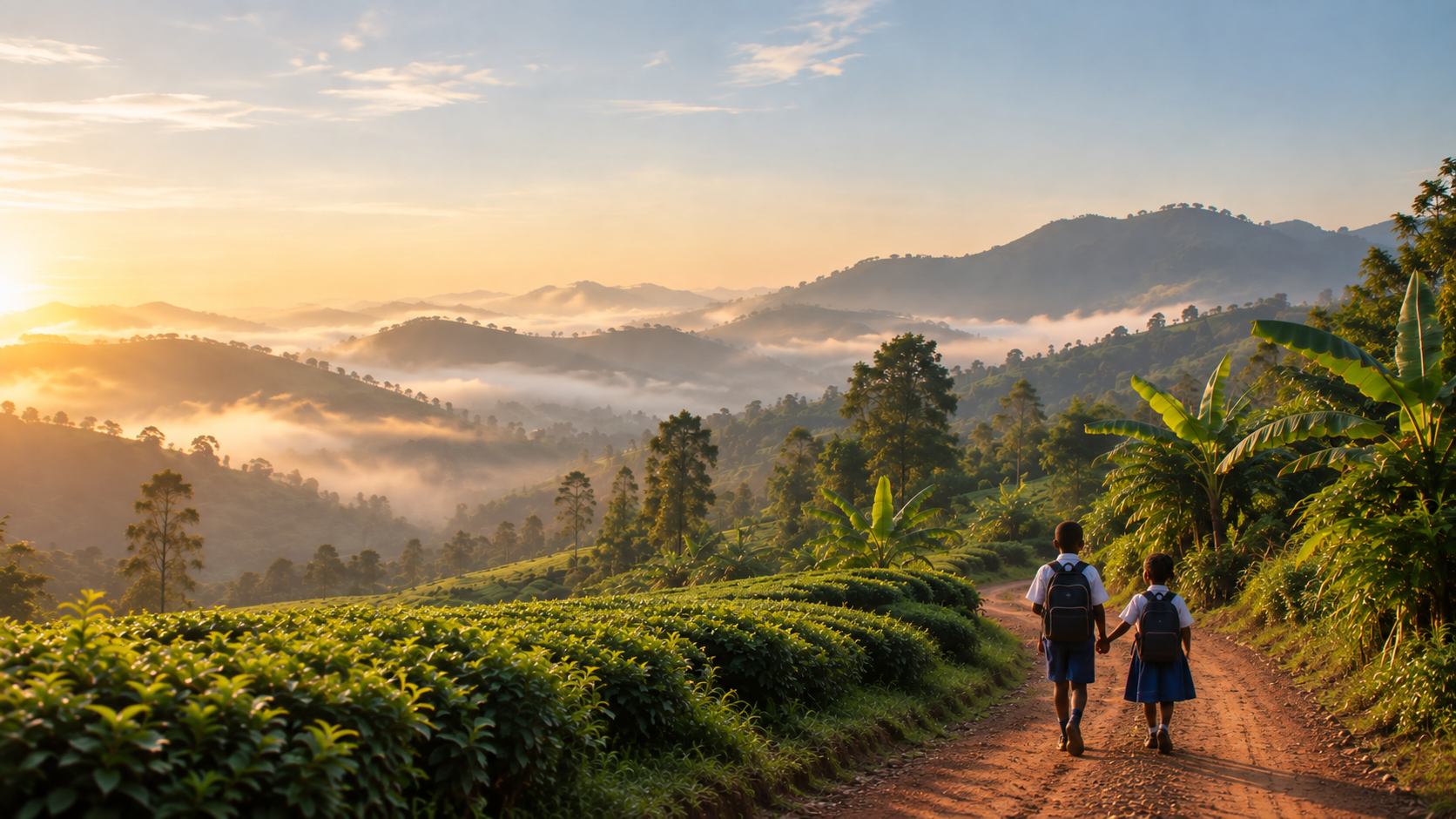
When I heard this story, secondhand, from people who work in Lushoto’s schools, what struck me wasn’t the decision itself. Children make impossible choices everywhere; poverty has always demanded them. What struck me was what Baraka reportedly said afterward, when he came back to visit, money in hand for his sister’s books and uniforms. He said he knew it wasn’t right. Not righteous, not noble, not a sacrifice he wanted anyone to admire. Just necessary. And he said he intended to go back eventually. Earn enough, save enough, return to his own education once his sister’s foothold was secure.
I keep turning that over. We tend to describe dropout as a failure, a child falling through a crack, a system that let someone down. Sometimes that is exactly what it is. But sometimes, like this, it is love wearing the disguise of a statistic. Baraka did not fall through anything. He built a bridge out of himself and walked his sister across it, fully aware of what it would cost him to be the one left on the other side.
I do not have a tidy resolution for this. I wish I did. In the work I do, foundational learning, teacher training, better classroom measurement, we are trying to fix the part of the system that decides whether children like Baraka’s sister learn to read in time to stay in school at all. That part matters enormously. Tanzania’s own national push right now, the Scientific Strategic Framework for Reading, Writing, and Arithmetic, says as much: what counts is not what is written in reports, but what a child can actually do in a classroom. It is the same ambition that drives the work we do at LearnImpact, an ambition worth having built an entire organization around.
But Baraka’s problem was never inside the classroom. It was arithmetic of a different kind entirely, the kind no assessment tool touches. One child’s future, weighed against another’s, on a scale that should never have existed in the first place.
What I can tell you is that his sister is still in school. That the coming years of her education might determine whether she reaches secondary school able to read fluently, do arithmetic without hesitation, and hold onto the kind of foothold Baraka gave up his own future to secure for her. Whether that foothold holds depends on things larger than one family’s math: whether her teachers can tell early that she’s struggling, whether someone notices before she’s three grades behind, whether the system around her classroom is built to catch her rather than simply record her failing.
That is the part I can work on. It is not the whole of Baraka’s story. But it is the part within reach, and reach matters, even when it cannot reach far enough to bring a fourteen year old boy back to that road through the tea and cardamom, at least not yet.
He said he’d go back. I choose to believe him.